Showing posts with label Anchor. Show all posts

05 October 2016

Anchor Research


What's the best anchor for a cruising boat like Bella to sport? Here's some research that might help answer that question:

Ancho Reset Tests - Practical Sailor - 2001

For more information about the "Bulwagga" in the article above click here.

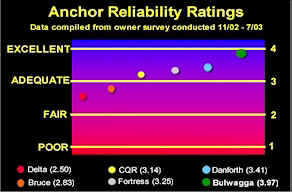
Another study illustrated in this graphic:


Here's a couple of videos that will show how the Bulwagga works:

Setting Video

Resetting Video

Here's another article that specifically addresses the Cruiser's anchoring needs. Click Here.

Here's a study that showed the Danforth (Bella's current ground tackle) failed their 400lb. test. Click Here.

In the reading I've done the best anchor for set, strength, reset, and stowage is the Spade. Click here for details. Also, at this link are videos of it in action. Here's a place we can purchase this anchor online click here. I think the steel version would be best for our purposes. The 44lb. S100 model would like be the best fit for our needs. Cost is $578.

One additional benefit to purchasing this anchor would be the ability to move the current Danforth anchor to stern anchor duties should the need for a larger stern anchor be prudent. As well it would be available as a backup primary anchor should the need to slip the spade anchor in an emergency.

More to follow....

22 October 2012

Anchoring Glossary

Anchor: A device designed to engage the bottom of a waterway, and through its resistance to movement, to maintain a vessel within a given radius.
Anchor chocks: Fittings on the deck of a vessel used to stow an anchor when it is not in use.
Anchor rode: Line or chain, or a combination of both, connecting an anchor to a vessel
Bow Chocks: Fittings on a vessel’s rail at or near the bow having jaws that serve as fairleads for an anchor rode or other lines.
Breaking Out The Anchor: Unsetting it by pulling up on the rode or other lines.
Ground Tackle: An overall term for anchors, anchor rode, fittings, etc., used for securing a vessel at anchor.
Hawsepipe: A cylindrical or elliptical pipe or casing in a vessel’s hull through which an anchor rode runs.
Horizontal Load: The horizontal force that is placed on an anchoring device by the vessel to which it is attached.
Mooring Bitt: A post through or attached to the deck of a vessel that is used to secure an anchor rode or other line to the vessel.
Scope: The ration of the length of the anchor rode currently in use to the vertical distance from the bow chocks to the bottom of the water (depth of water plus the height of the chocks above the water).
Tripping An Anchor: Using a line attached to the crown or head of an anchor fouled in the bottom to pull it out backward (to “trip” it).
Vertical Load: The downward force placed on the bow of the vessel by its anchor rode.

Types of Seabeds
Qualifying Terms
S Sand
M Mud
Cy, Cl Clay
G Gravel
Co Coral
Cb Cobbles
Sn Shingle
P Pebbles
St Stones
Rk, Rky Rock, Rocky
Ch Chalk
Sh Shells
Wd Weed
S/M Two layers (ex: sand over mud)
s small
f fine
m medium
c coarse
h hard
sm small
bk broken
v volcanic

Note: lowercase letters used for qualifying terms.

17 May 2008

"Skating" or "Sailing on the Anchor" Solutions

In last month's letters we talked about boats "sailing on the anchor", going back and forth on one tack then the other. Of course the many types of boats; full keels, fin keels, light, heavy, high profiles, low profiles, multihulls, all have different degrees of liveliness at anchor. We received many creative and practical suggestions from our readers but chose the solutions below as the most practical and universal ways to help calm down your boat a bit.
Good questions and answers on Page 17 of the September 2003 on the subject of "sailing" or "skating" at the anchor. Keeping the boat as still as possible at anchor is a good thing, because:
  • 1. It isn't fun.
  • 2. You might smack into another boat.
  • 3. You might pull your anchor and drag.
There is probably no way to stop the action of sailing back and forth as long as boats float and winds and current are variable-but here are three ways to lessen the problem.
First, as Richard wrote: Make sure the anchor rode is pulling along the centerline of the boat, not from one side or the other-even a few inches can make a difference.
The best way to accomplish this is with bridles leading from the bow chocks out to the anchor line. The anchor line is slacked enough so that the strain of holding the boat is taken up by the bridles. Then when the boat starts to "sail" off to one side, the strain of the anchor will be taken on the opposite side's bridle-thus dampening the movement. Second: On a cordage anchor rode, particularly, make up a "soldier" or weight to send down the rode on a shackle or block. It should ride at least double the distance from the bow to the waterline. This weight will keep a steady pull on the anchor rode and will also act as a "drogue" in the water to slow the side to side motion. A stout canvas bucket full of rocks or old engine parts is a good, spur of the moment, choice. A cast lead weight, swaddled in canvas or leather, with an eye cast in it is the ideal "soldier".
Third: Lower a weight, such as a bunch of old chain or a piece of canvas or vinyl full of rocks, over the bow on a line just long enough to have the weight drag along the bottom at high tide. Usually, at night, in Pacific Northwest summers, the tidal range is not too great. However, if it is, the line might have to be taken in as the tide falls and payed out when it rises, to keep the weight on the bottom, but not on too long a scope.

Freeman Beach
Point Roberts, WA

I would recommend that the writer have an "anchor sail" (also known as riding sail) made for use during a windy anchorage. I had one made for my San Juan 28, NOLHI (No Other Love Have I), and have used it on numerous occasions on my cruises into British Columbia and around Puget Sound. During my solo Vancouver Island circumnavigation in 2002 I used it during a gale while anchored at Port Hardy where my Skywatch wind meter recorded a wind of 39 knots.
Once raised the sail keeps the bow pointed directly into the wind and removes all the lurching and dancing while riding out a storm. The difference is simply amazing.
The sail should be tailored to your boat. The dimensions for NOLHI's are 10x9x5 and made to storm sail specifications. This may seem like a rather large amount of square footage but better to be too large than too small; you can always have it cut down in size if necessary. It is interesting to note that the sail loft owner made a smaller one for her Newport 30 and reported that it did NOT work very well.
As you can see from the attached photos, it is hanked onto the backstay, hoisted up with the mainsail halyard, and secured at the backstay base. The forward edge of the sail is secured to a cleat above the cabin entry and also downward to the traveler. It is installed as tight as I can get it to remove all slack and wrinkles in the sail. It makes all the difference in the world and I wouldn't leave home without it!
Lastly, I have NOT seen anyone else using such a sail either here or in British Columbia.

Cheers,
Mike Hirko
Gig Harbor, WA

10 March 2008

Anchor Aweigh!

A necessary skill for all sailors is the ability to safely anchor. I've been reading all I can find on the subject of anchoring. However, as with most things sailing, there is only so much you can learn from books. Real sailing skill comes from experience.

So, this past weekend marked the first time this sailor would drop anchor. Three of us, Terry, Ryan, and I set out to anchor off Island White. White Island is within Long Beach Harbor. Yeah, I know as safe an anchorage as you can find...as it should be the first time.

Here's a link to our anchoring site:


View Larger Map

We anchored in ~50 feet of water with a sea floor of mud. We dropped 360 feet of rode of which 210 feet was chain. The 40lb Danforth anchor set firm and we held tight all night.

Lessons Learned

  1. With this much chain make sure it isn't twisted prior to leaving port. Twist chain skips on the windlass.
  2. Make sure the entire rode is marked for length. In our case the chain rode was well marked but the nylon line was not. Estimating length is not recommended as accuracy in determining scope is very important to safely anchoring.
  3. Drop anchor slowly to a scope of ~3:1 before motoring in reverse to set anchor.
  4. Tie off the anchor line to a cleat and then to looped dock line cleated to each side of the bow. This will divide the anchor line stress between two cleats, eliminate stress at the bowsprit, reduce heat at chafe points, and allow the boat to move freely in current and wind.
  5. Once a suitable anchor location is located, determine appropriate scope hence rode necessary. If only deploying a bow anchor circle the sweep zone with the boat to determine depth in the anchor zone. it should be consistent to avoid fouling your line or worse grounding your boat in low tide.
  6. When lowering your anchor mark this location on your electronic chart. This will help you tell others where your anchor is if needed as well as help you verify your rode lenght/scope.
  7. Use your electronic chart and radar to determine the true distance from objects. This will help prevent you swinging into other boats, rocks, or shore.
  8. Use gloves when handling chain/rope rode.
  9. When weighing anchor don't use the windlass to pull the boat. Draw the boat forward under power as another brings in the rode. Once directly over the anchor pull in slack rode. Then pull forward slowly until rode tigthens and then power forward to break anchor free.
  10. If the anchor comes up muddy you can run the boat in reverse to clean it.
All in all it was a successful learning experience. I still need several more in different conditions and situations to feel confident in anchoring.